Guests Experience One Resort. So Why Is the Operation So Fragmented

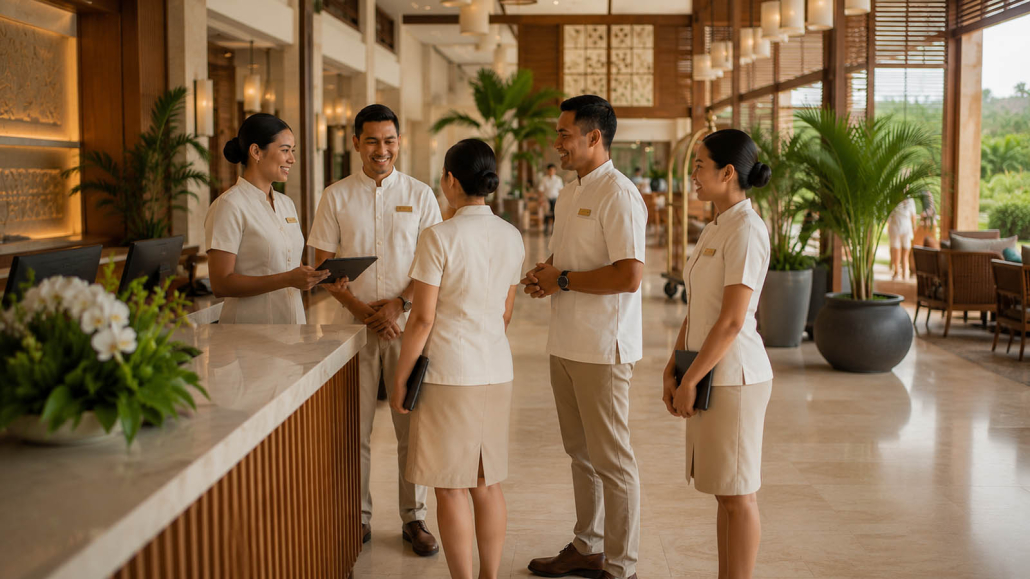
Guests do not experience a resort as a collection of departments.

They do not see the handovers between teams, the workflows behind a request or the systems staff move between to make things happen.

They see one resort.

When they make a request, they expect the resort to understand it, act on it and follow it through. Yet operationally, that single experience can look very different.

 A Digital Request. A Very Manual Process.

Consider something as simple as a guest asking for a birthday cake.

To the guest, it is one request made to one resort.

Behind the scenes, it may involve Guest Relations, Food & Beverage, the kitchen, payment approval, delivery coordination and a final check that everything happened as promised.

The request may begin digitally, but what follows can still depend on emails, WhatsApp group messages, spreadsheets, phone calls and manual follow-up.

The simplicity of the request is exactly the point.

If something this straightforward requires several systems, departments and handovers, the complexity belongs to the operation behind it.

The Conversation Is Only the Beginning

Guest-facing technology has made it easier for guests to communicate and for teams to respond quickly.

But responding to a request and delivering it are two different things.

Once the message is received, information still has to reach the right teams, ownership has to be clear and the request has to be followed through until the promised outcome is delivered.

A seamless conversation can therefore sit on top of a fragmented operation.

The guest sees the message. The resort has to manage everything that happens next.

Departments Are Necessary. Departmental Journeys Are Not.

Resorts need departments. They create expertise, accountability and structure.

The challenge is that guest journeys rarely stay within them.

A maintenance issue may involve Guest Relations, Engineering, Housekeeping and Front Office. An activity booking may affect transport, payment, equipment and communication across several teams.

Each department may perform its part well.

But the guest experiences the outcome as a whole.

That creates a contradiction: the guest is having one experience while the resort is managing multiple operational fragments.

 When Everyone Sees Their Part, Who Sees the Whole?

Most resorts are not short of information.

Housekeeping may see room status. Maintenance can see open work orders. Guest Relations can see conversations. Restaurant and activity systems can see reservations.

The problem is that these are often different views of the same guest journey.

A task being completed does not necessarily mean the request has been fulfilled. A message being answered does not mean the promised action happened.

And every time information is copied, forwarded, re-entered or passed manually between systems, there is another opportunity for something to be delayed, duplicated, misunderstood or missed.

Where systems stop, staff often fill the gaps through email chains, WhatsApp groups, spreadsheets and follow-up calls.

Everyone may be able to see their part.

Who can see the whole journey?

 The Human Operations Layer Reappears

This is where the ‘Human Operations Layer’  becomes important.

When technology does not connect the operational journey, people do it themselves.

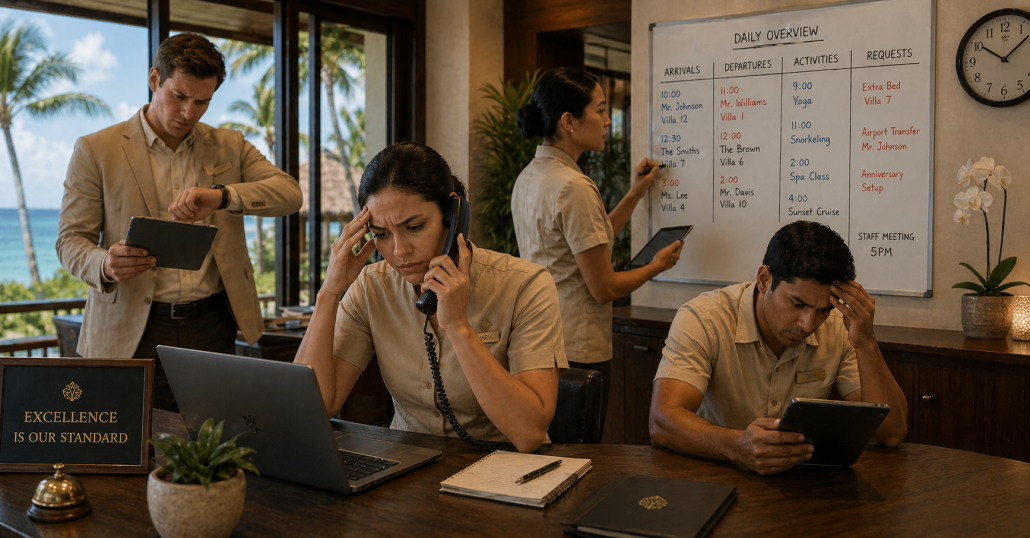
They carry information between systems, forward emails, post updates in WhatsApp groups, update spreadsheets, check whether another department has acted and chase anything that is running late.

Each manual step keeps the operation moving, but it also creates another point where information can be lost, duplicated or misinterpreted.

The guest does not see those handovers.

They simply experience whether the resort delivered what was promised.

This is why fragmented operations can remain largely invisible. Resort teams are exceptionally good at compensating for them.

The guest experiences one resort because the people working within it continually make the operation behave like one.

The Human Operating Layer carries the complexity created by the gap between a single guest journey and a
fragmented operating model.

 What If Technology Followed the Journey Instead?

Perhaps the question should not simply be how individual departments can become more efficient.

It should be how the resort can operate more effectively as a whole.

What if a guest request could move across the operation without being repeatedly re-entered, reinterpreted or manually chased?

What if every team had the context it needed, ownership remained clear and managers could see the complete journey rather than a collection of departmental snapshots?

That does not require departments to disappear.

It requires the technology supporting them to recognise that the guest journey moves between them.

 Building a Better-Connected Operation

Building a better-connected operation does not have to mean a major overhaul of the resort’s entire technology environment.

The opportunity is to reduce fragmentation by bringing more of the guest journey, departmental workflows and operational visibility into one connected environment.

That may mean replacing some existing systems, integrating with others and removing the spreadsheets, emails, WhatsApp group messages and manual follow-up that currently sit between them.

Instead of staff acting as the connection between disconnected systems and processes, the operation itself becomes more connected.

This is not about replacing people or removing the judgement and flexibility hospitality depends on.

It is about allowing those strengths to be focused where they create the most value: caring for guests, solving problems and delivering exceptional experiences.

Because guests already experience one resort.
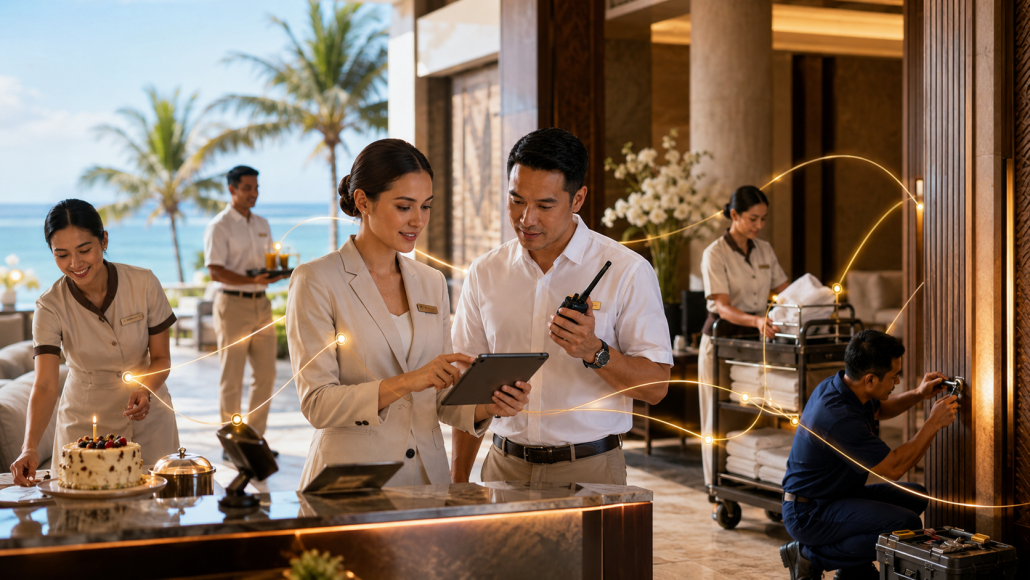
The operation behind that experience should work as one too.

The People Between the Systems

Most resorts have some form of technology in their daily operation.

There are platforms out there for guest messaging, housekeeping, maintenance, restaurant reservations, activities and task management. Some support individual departments, while others coordinate work across several teams.

Yet much of the real operation still happens outside them.

It happens in spreadsheets and emails, in group messaging chats and in printed forms, manual handovers and follow-up checks.

Together, these processes form a Human Operating Layer: a parallel system powered by resort staff to manage the work that falls between the official platforms.

The Work Between the Systems

Each platform may perform its own role extremely well. The challenge however is that resort operations rarely remain within one system or function.

A simple guest request might begin as a message, but triggers work across several departments and needs to be monitored until the final outcome is delivered.

Different platforms may manage certain parts of that journey. The Human Operating Layer manages the rest.

Consider a guest requesting a birthday cake.

Workarounds Have Become Operational Infrastructure

Spreadsheets, group chats and manual processes are often described as workarounds whereas in reality, many resorts depend on them every single day.

But each workaround creates another place to look, another process to remember and another dependency to manage.

Eventually, the workaround stops looking temporary and it becomes part of the resort’s operating infrastructure.

Staff Carry the Complexity

The Human Operating Layer does not operate automatically. Resort staff make it work. They interpret requests, transfer information, update spreadsheets, alert colleagues and chase outstanding actions. They remember which process applies, where information is held and who needs to act next.

In effect, people become the connection between the resort’s systems.

This work is easy to underestimate because it is spread across hundreds of small actions. Each action may take only a few minutes. Across multiple teams, shifts and guest requests, those minutes accumulate and so to does the risk of something going wrong.

Every manual step creates another opportunity for information to be delayed, duplicated, misunderstood or missed.

The individual systems may all be working correctly but the staff still carry the complexity of making them work together.

The Operation Depends on What It Cannot Easily See

The Human Operating Layer often remains hidden because resort teams are so effective at compensating for it. Guests still receive their cakes. Transfers are arranged. Maintenance issues are resolved. Restaurant bookings are confirmed.

The outcome is delivered, but the effort behind it is largely invisible. Because the operation continues to function, its dependence on these informal processes can be difficult to recognise.

A useful question for any resort is:

What would stop working if every spreadsheet, group chat and manual check disappeared tomorrow?

The answer reveals where the formal technology ends and staff have to take over.

Hospitality will always depend on people, judgement and communication. But those strengths should be used to care for guests, solve problems and create memorable experiences—not to hold disconnected processes together.

The Human Operating Layer is very likely keeping the resort running.

The question is how much complexity the team is carrying to sustain it.

Building a Better-Connected Operation

The answer is rarely to replace every system a resort already uses.

The opportunity lies elsewhere: creating an operational layer that brings systems, departments and workflows together, giving teams visibility of the complete guest journey while reducing the need for spreadsheets, emails and manual follow-up.

Instead of staff acting as the connection between disconnected systems, the operation itself becomes connected.

This is not about replacing people or removing the judgement and flexibility that hospitality depends on.

It is about allowing those strengths to be focused where they create the most value: caring for guests, solving problems and delivering exceptional experiences.

When Did Running a Resort Become This Complicated?

It didn’t happen overnight.

As hospitality evolved, new technology emerged to solve individual challenges. Resorts adopted specialist, best-of-breed software for guest messaging, housekeeping, maintenance, activities and countless other operational tasks. Alongside those systems came spreadsheets, group messaging apps, emails and manual workarounds to bridge the gaps.

At the time, every decision made sense. Each new tool solved a specific problem.

The challenge was that very few of these solutions were designed specifically for the way resorts operate.

Instead of supporting one connected operation, they were built to serve individual departments or functions. Over time, resorts didn’t just invest in technology, they accumulated it.

The result is an operational environment where information lives in multiple places, teams move constantly between different systems, and manual processes still exist simply because the technology was never designed to work as one.

Is Integration Really the Answer?

For years, the industry’s answer has been straightforward: integrate everything.

On paper, it sounds like the logical solution.

In reality, integrations are only ever as capable as the systems they’re connecting. They rely on third-party software providers making data available, supporting ongoing development, and maintaining those connections over time. Even then, the information you need isn’t always the information the integration can deliver.

Every integration introduces another dependency, another implementation project, another cost, and another point of failure.

Rather than simplifying operations, many resorts end up investing significant time and money trying to make separate systems behave like one.

It’s a bit like trying to complete a jigsaw puzzle using pieces from different boxes. You might force some of them together, but you’ll never create the complete picture.

Perhaps There’s a Different Approach

Maybe the real question isn’t, “How do we connect everything?”

Maybe it’s, “Why do we need so many different systems in the first place?”

For decades, the hospitality technology market has been built around single-purpose solutions. Browse almost any hospitality software directory and you’ll find products organised by department – housekeeping, guest messaging, maintenance, concierge, activities, and so on.

That’s how the industry has evolved.

But the needs of modern resorts have evolved too.

Perhaps the future isn’t about adding another application to the technology stack or connecting another integration.

Perhaps it’s about replacing multiple disconnected systems with one platform designed specifically for the way resorts actually operate.

A Simpler Future for Resort Operations

At Eleanor, we’ve always believed the best technology is the technology your teams barely have to think about.

That belief didn’t come from building software first. It came from years spent working within resorts, seeing the same operational challenges repeated day after day and asking a simple question:

There has to be a better way?

That’s why Eleanor was designed specifically for resorts.

Not as another standalone application.

Not as another integration.

But as one connected platform that replaces unnecessary complexity, gives every department the same real-time visibility, and helps resort teams spend less time managing systems and more time delivering exceptional guest experiences.

Running a resort will always be demanding.

Managing the technology behind it shouldn’t be.

5 Signs Your Resort Operations Are More Inefficient Than You Think

Think your resort operations are running efficiently? Discover five hidden signs they may be costing your team time and productivity.

It’s time to change the way you think about your guest feedback strategy. Why wait until your guest has left to ask them for their opinion?

In the ever-evolving world of hospitality, the importance of one thing remains the same – guest feedback and online ratings is crucial to continuous improvement and staying ahead of the competition. To keep your resort at the top of its game, it’s essential to understand what your guests love, what makes their stay unforgettable and more importantly what they’d like improved and where the shortcomings were in the service received.

It’s important to have a system in place that allows you to collate this feedback while the guest is still staying with you and that in the case of shortcomings in service, you have the chance for recovery and corrective action. The hotelier’s nightmare is reading about a poor experience after the guest has left, or worse, when the review is publicly available on TripAdvisor, Google or any other online portal.

The impact of online reviews is well-known in the travel industry:

  • A TrustYou heat mapping study found that given equal prices travellers are 3.9 times more likely to choose a hotel with a higher review score. In fact, 76% of travellers said they were willing to pay more for a hotel with higher review scores.
  • According to a study conducted by Harvard Business School, a 1-star increase in review ratings could lead to a 5-9% increase in revenue;
  • Resolve a complaint in the customer’s favour and they will return to do business with you again 70% of the time. Up to 95% of customers will give you a second chance if you handle their complaint successfully and promptly *


* As per statistics shared by customerthermometer.com


Building A Robust & Real Time Feedback Strategy

A robust and real-time feedback strategy will allow you to elevate your guest experience and allow for a more solid foundation for improving your ranking on review sites such as TripAdvisor, Google and OTA booking sites.  An essential first step in ensuring your resort is able to capture guest sentiment is to allow guests to easily provide feedback at various touchpoints during their stay.

Post Arrival

The courtesy call offered by high-end resorts has served the industry well, but is very hit-and-miss in most cases as to whether the guest can be reached.  It’s an uncomfortable process for both the resort employee and the guest.  Feedback provided by the guest is put on the spot like this is likely to be inaccurate, creating a false impression of their real opinion.

However, this is such a crucial part of the guest journey as it is the first interaction on-property and the chance to influence the rest of the stay is enormous. So finding an unobtrusive yet effective way to capture true sentiment at this stage is essential.

Post Experience / Activity

Once your guest has settled in and is into the swing of their holiday, ensuring that the service delivery and experiences they have during their stay are as important as making sure the first impressions are meeting expectations.  This becomes even more relevant if your resort is using third parties for some service delivery.  Capturing feedback and sentiment at this part of the guest journey can provide unique insight into your departments and whether they are meeting guest expectations.  This stage of the journey is also an essential component of a robust and real-time feedback strategy.

Pre Departure 

All too often, guests are asked for their feedback either at checkout or even after departure.  If you’re asking for guest feedback on checkout and their sentiment is negative, you’re reaffirming those negative experiences at the point of departure, which is something that should be avoided as much as possible.  Having guests leave your property with negative feedback as one of the last things they do doesn’t make sense. Try to find a way to capture guest sentiment at a time of the journey that allows you to correct the issue and have the guest leave with just positive thoughts about the resort.

The Path to Excellence

Eleanor’s In-Stay Survey is the secret weapon in crafting a feedback strategy that puts your resort ahead. Post-arrival surveys offer immediate guest sentiment feedback, in-the-moment feedback helps refine the experience, and pre-departure surveys ensure you have the opportunity for any last-minute service recovery to ensure your guest leaves happy. The knock-on effect of this is to see improved post-stay ratings and reviews on public-facing sites such as TripAdvisor, Google, Booking.com and other OTAs.


Improving Guest Engagement: Eleanor’s Chat Feature Delivers Exceptional Benefits

Effective communication lies at the heart of delivering exceptional guest experiences. Eleanor’s chat feature transforms the landscape of guest engagement for resorts, bringing forth many benefits that position it as an indispensable tool for any property. Let’s delve into the advantages it offers:


  1. Personalised Communication: Eleanor’s chat feature allows resorts to communicate with guests personally. From pre-arrival queries to in-stay assistance, it enables tailored interactions that enhance the guest’s sense of being valuable and looked after.


  1. Instant Assistance: Guests appreciate quick responses to their questions and requests. Eleanor’s chat ensures immediate assistance, whether getting recommendations or booking a spa treatment.


  1. Enhanced Guest Satisfaction: Satisfied guests are more likely to leave positive reviews and return for future stays. The chat feature helps resolve issues promptly, boosting overall guest satisfaction.


  1. Real-time Feedback: Guests can request common service requests and report issues directly through the chat interface, allowing resorts to address concerns in real-time and improve service quality.  Operations are also streamlined as a result of Eleanor’s Tasks & Guest Requests module integration.


  1. Increase in Upsell Opportunities: Resorts can use the chat feature to promote on-site services and activities, increasing revenue through upselling.


  1. Data Insights: The chat feature generates valuable data on guest preferences and behaviour, which resorts can use to refine their offerings and marketing strategies.


In today’s competitive hospitality industry, Eleanor’s chat feature empowers resorts to elevate their guest experiences. Take advantage of this opportunity to enhance guest engagement and satisfaction. Get started with Eleanor today and unlock a world of possibilities for your resort’s success.

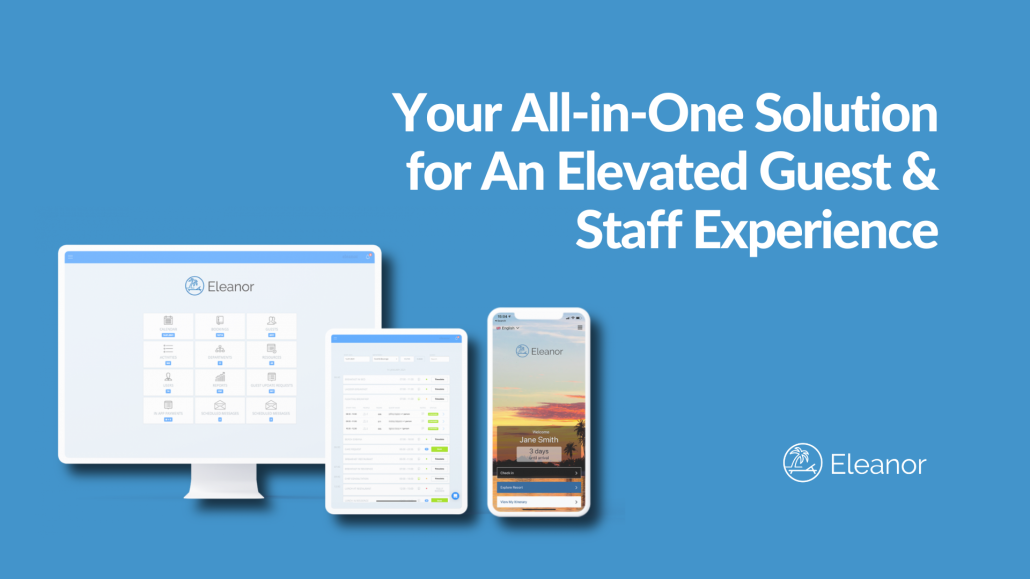
Eleanor: Your All-in-One Solution for An Elevated Guest & Staff Experience

In the dynamic world of hospitality, seamless resort operations are the key to delivering exceptional guest experiences. Meet Eleanor, the revolutionary digital concierge platform consolidating essential resort applications and tools and empowering hospitality professionals to unlock operational efficiencies, improve communication, cut costs, and elevate the guest experience.


No more juggling multiple apps or platforms; with Eleanor, everything you need is at your fingertips. Let’s explore the core features of Eleanor that make it a must-have for every resort:


Centralized Hub for All Departments

  • Eleanor is the centralised hub, bringing together a range of resort operations and processes under one unified platform.
  • From guest check-ins and restaurant reservations, spa treatments and activities to housekeeping and maintenance tasks, all aspects of resort management are seamlessly integrated.


Cost-Effective Single Solution

  • Say goodbye to the burden of multiple software subscriptions and the associated expenses. Eleanor offers a cost-effective solution by consolidating essential tools into one.
  • Save time and money on different license requirements and training for your team.


Elevate Your Guest Experience

  • Resorts can create a memorable guest experience by offering personalised services and itineraries.
  • Communicate effectively and directly with your guests with in-app messages and upselling push notifications.


Smart Task Management

  • Eleanor’s innovative Task & Guest Request Module simplifies and optimises task assignment, tracking, and completion for various resort departments.
  • Get smart and actionable data on task acceptance and completion rates and help streamline operations.


Customizable Guest Requests

  • Eleanor empowers guests to make personalised requests through the resort’s mobile application, enhancing their in-stay experience.
  • These requests automatically trigger corresponding tasks, ensuring seamless integration with the Task & Guest Request Module.


Maximize Revenue Streams

  • The integrated reservation system within Eleanor enables resorts to manage direct bookings for restaurants, spa services, activities, and excursions, boosting profitability and providing guests with tailor-made experiences.
  • Upsell opportunities to make sure that there are no empty seats in restaurants or activities can be achieved through push notifications and messaging.


Improved Review Ratings

  • Eleanor’s In-stay Survey becomes a critical tool for service recovery in case of any service hiccups or guest concerns. Resort staff can promptly address issues and take immediate action, showcasing the resort’s commitment to resolving guest concerns and exceeding expectations.
  • Resorts can enhance guest satisfaction and foster guest loyalty by actively engaging with guests through surveys and promptly responding to feedback. The end result is an improved review rating on TripAdvisor, OTA sites or Google.


Performance Insights for Continuous Improvement

  • In-stay Survey results provide valuable performance data that empowers resort management to make data-driven decisions. By analyzing survey feedback, resorts can identify strengths and areas for improvement, allowing them to continuously refine their services and elevate the guest experience.
  • The transparent tracking of service levels and performance metrics within Eleanor’s In-stay Survey module makes it an indispensable tool for achieving service excellence.


Eleanor stands as a game-changing all-in-one solution for both staff and guest experiences. Embrace Eleanor, and witness a new era of efficiency, productivity, and guest satisfaction unfold in your resort.

Streamlining Operations with Task & Guest Requests in Eleanor

Efficiently managing guest requests and the day-to-day tasks that arise for housekeeping, front office, engineering, and maintenance departments is crucial in any resort or hotel. A system that monitors and tracks these tasks and requests can help save time, money, and resources while elevating guest satisfaction.

Eleanor is pleased to announce to launch of its Task & Guest Request Module to streamline operations and enhance communication among staff members, guests, and management teams. By leveraging this add-on module within the Eleanor suite, hospitality professionals can optimise task assignment, tracking, and completion, boosting their operations’ overall efficiency and effectiveness.


One System 

Existing Eleanor users can benefit from the new module and provide access to users directly from the existing dashboard. There is no need for a separate application or software for managing tasks and guest requests – users have a single login and can complete the day-to-day requirements directly from Eleanor.


A Centralised Task Management System

The Task Module acts as a centralised hub, allowing different departments within a resort to manage their respective tasks effectively. Whether it is the front office, housekeeping, or engineering and maintenance, each department can have separate setups, enabling prompt and accurate task assignments based on individual requirements. Sub-departments can also be accommodated, further enhancing specialisation and efficiency in handling specific tasks, such as electrical, plumbing, or carpentry.

Notifications on task creation are sent to the relevant team members, with escalation limits and parameters able to be set to ensure the timely execution of the tasks.

A powerful reporting feature is bundled into the module to allow management to keep track of performance and ensure that response and execution times are within your KPIs.


Elevate your guest experience with Guest Requests

Common guest requests are a great way to help streamline operations and reduce the number of team members required to execute simple requests from your guests. Whether it be refilling a mini-bar, requesting more towels, or asking for laundry to be collected, Eleanor’s Guest Request feature allows these common tasks to be initiated directly from the resort’s mobile application.

Requests are customisable, with the initiation of a request automatically creating a task for the appropriate department, integrating seamlessly with the Tasks Module.

Guests are automatically updated with the progress of their requests as updates are applied by the team completing the task. This simple but significant feature is already proving invaluable to the flow of information to guests.


Integration with In-Stay Surveys

The Task & Guest Request module integrates effortlessly with Eleanor’s In Stay Survey module, allowing tasks to be created from individual survey feedback. This ensures that a complete overview of any service recovery related to In Stay Surveys is transparent, simple to keep track of, and measurable.

The Task Module in Eleanor empowers hospitality professionals to manage tasks effectively, streamline operations, and enhance guest satisfaction. With its user-friendly interface, seamless task assignment and tracking, real-time updates, and integration with the mobile resort application, the module extends the core capabilities of the Eleanor platform, offering even more operational tools within one single system. By embracing this innovative solution, resorts and hotels can elevate their operations, improve collaboration among staff members, and ultimately elevate their guest experience.


    Contact Us

    Please complete the following so that one of our team can reach out to explain more about Eleanor. Our team will lead you through the process for a smooth and simple setup.


    This site is protected by reCAPTCHA and the Google Privacy Policy and Terms of Service apply.


    Eleanor Centralised Booking Platform for Resorts

    Your Butler / Guest Service Team’s New Best Friend